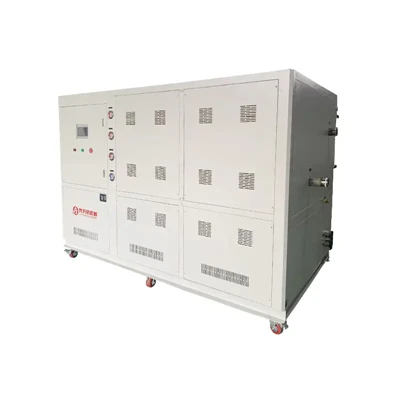
As a seasoned provider of industrial cooling equipment, I’ve witnessed firsthand the pivotal role that control systems play in the efficient operation of these essential machines. In the industrial landscape, cooling equipment is not just about maintaining low temperatures; it’s about precision, reliability, and adaptability. Today, we’ll delve into the various control systems of industrial cooling equipment, exploring their features, advantages, and applications. Industrial Cooling Equipment
1. On – Off Control System
The on – off control system is perhaps the most basic and straightforward type of control system used in industrial cooling equipment. Its operation is simple: when the temperature of the system rises above a pre – set upper limit, the cooling equipment is turned on. Conversely, when the temperature drops below a pre – set lower limit, the equipment is turned off.
This system’s simplicity is its greatest strength. It is easy to install, understand, and maintain. For small – scale industrial applications or where strict temperature control is not a critical requirement, on – off control systems are often the go – to choice. For example, in some simple storage facilities where the stored items can tolerate a certain temperature range, an on – off controlled cooling unit can provide an economical cooling solution.
However, on – off control systems also have their drawbacks. The frequent starting and stopping of the equipment can cause excessive wear and tear on the components, leading to a shorter lifespan. Additionally, the temperature fluctuations in an on – off controlled system can be relatively large, which may not be suitable for applications that demand high – precision temperature control, such as in some pharmaceutical or electronics manufacturing processes.
2. Proportional Control System
A proportional control system is a more advanced approach compared to on – off control. In a proportional control system, the output of the cooling equipment is proportional to the error between the actual temperature and the set – point temperature. The error is calculated as the difference between the desired temperature and the current temperature.
The main advantage of a proportional control system is that it can reduce the temperature fluctuations compared to an on – off system. As the temperature approaches the set – point, the cooling capacity of the equipment is gradually adjusted rather than simply turning on or off. This results in a more stable temperature environment, which is beneficial for industrial processes that require consistent cooling.
For instance, in a chemical processing plant, where chemical reactions are sensitive to temperature changes, a proportional control system can ensure that the reaction environment remains within a narrow temperature range, thus improving the quality and yield of the products. However, proportional control systems alone may not be able to eliminate the steady – state error completely. There will still be a small difference between the set – point temperature and the actual temperature in the long run.
3. Proportional – Integral – Derivative (PID) Control System
The PID control system is the gold standard in industrial temperature control. It combines three control actions: proportional, integral, and derivative.
The proportional action, as mentioned earlier, adjusts the output in proportion to the current error. The integral action considers the cumulative error over time. It helps to eliminate the steady – state error that may exist in a proportional control system. By integrating the error over time, the integral term can gradually adjust the output until the actual temperature reaches the set – point.
The derivative action, on the other hand, is based on the rate of change of the error. It anticipates future changes in the temperature and adjusts the output accordingly. This helps to improve the system’s response time and stability, especially when there are sudden changes in the load or external conditions.
PID control systems are widely used in a variety of industrial cooling applications, from large – scale power plants to high – tech semiconductor manufacturing facilities. They offer high – precision temperature control, fast response times, and excellent stability. However, tuning a PID control system can be a complex task. It requires a good understanding of the system’s dynamics and careful adjustment of the three control parameters (proportional gain, integral time, and derivative time) to achieve optimal performance.
4. Programmable Logic Controller (PLC) – Based Control System
PLC – based control systems are becoming increasingly popular in industrial cooling applications. A PLC is a digital computer that is designed for industrial automation. It can be programmed to control various aspects of the cooling equipment, such as temperature, flow rate, and pressure.
One of the key advantages of a PLC – based control system is its flexibility. The PLC can be easily reprogrammed to adapt to different operating conditions or process requirements. For example, if a factory decides to change its production process and requires different temperature settings for the cooling equipment, the PLC can be quickly reconfigured without the need for major hardware changes.
PLC – based control systems also offer excellent monitoring and diagnostic capabilities. They can collect and analyze data from sensors in the cooling equipment, such as temperature sensors, pressure sensors, and flow meters. This data can then be used to detect potential problems early, optimize the operation of the equipment, and reduce maintenance costs.
In addition, PLCs can be integrated with other industrial control systems, such as Supervisory Control and Data Acquisition (SCADA) systems. This allows for centralized control and monitoring of multiple cooling units across a large industrial site.
5. Intelligent Control Systems
With the development of artificial intelligence and the Internet of Things (IoT), intelligent control systems are emerging as the next generation of control systems for industrial cooling equipment. These systems use advanced algorithms, such as machine learning and fuzzy logic, to optimize the operation of the cooling equipment.
Machine learning algorithms can analyze large amounts of historical data from the cooling equipment, including temperature, energy consumption, and maintenance records. Based on this analysis, the algorithm can predict future performance, identify potential faults, and adjust the control parameters automatically to optimize energy efficiency.
Fuzzy logic is another powerful tool in intelligent control systems. It allows the control system to handle uncertainty and imprecise information more effectively. For example, in an industrial cooling system where the load may vary in a complex and unpredictable way, a fuzzy logic – based control system can make more flexible and intelligent decisions compared to traditional control systems.
Intelligent control systems also enable remote monitoring and control of the cooling equipment. Through IoT connectivity, operators can monitor the status of the cooling equipment in real – time from anywhere in the world and make adjustments as needed.
Choosing the Right Control System
Selecting the appropriate control system for industrial cooling equipment depends on several factors. Firstly, the nature of the industrial process is crucial. Applications that require high – precision temperature control, such as in the food and beverage industry or semiconductor manufacturing, will typically need more advanced control systems like PID or intelligent control systems.
The size and complexity of the cooling system also play a role. A large – scale industrial cooling system with multiple units may benefit from a PLC – based control system that allows for centralized management and monitoring. On the other hand, a small – scale cooling unit in a simple workshop may be adequately controlled by an on – off or proportional control system.
Cost is also an important consideration. More advanced control systems generally come with a higher price tag, both in terms of initial investment and maintenance. Therefore, it is necessary to balance the performance requirements with the budget constraints.
As a leading supplier of industrial cooling equipment, we understand that every customer’s needs are unique. We offer a wide range of cooling equipment equipped with different control systems to meet the diverse requirements of our clients. Whether you need a basic on – off controlled unit for a simple application or a state – of – the – art intelligent control system for a high – tech manufacturing process, we have the expertise and the products to provide you with the optimal solution.
If you are in the market for industrial cooling equipment and are looking for a reliable partner to help you choose the right control system, we encourage you to reach out to us. Our team of experts is ready to discuss your specific needs and provide you with customized solutions. We are committed to delivering high – quality products and excellent after – sales service to ensure the smooth operation of your industrial cooling systems.
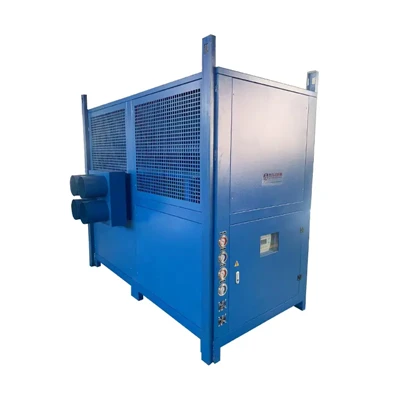
Screw Chillers Contact us today to start a discussion about your industrial cooling requirements and explore how our cutting – edge control systems can benefit your business.
References
- Incropera, F. P., & DeWitt, D. P. (2002). Fundamentals of Heat and Mass Transfer. John Wiley & Sons.
- Dorf, R. C., & Bishop, R. H. (2016). Modern Control Systems. Pearson.
- Krenzien, G. (2008). Industrial Refrigeration Handbook. Springer.
Kunshan Aotianxin Machinery Co., Ltd.
We’re well-known as one of the most reliable industrial cooling equipment manufacturers in China. With abundant experience, our factory offer high quality industrial cooling equipment made in China with low price. If you have any enquiry about quotation and free sample, please feel free to email us.
Address: 550 Shengguang Road, Bacheng Town, Kunshan City, Jiangsu Province
E-mail: 1516722561@qq.com
WebSite: https://www.atxks.com/
